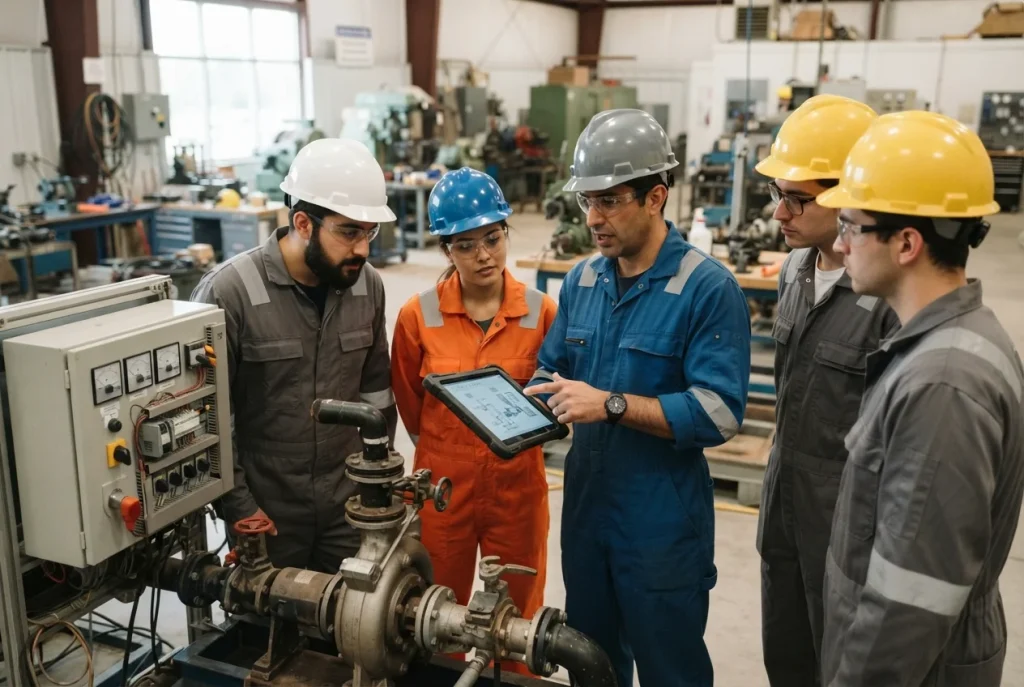
The energy industry is changing quickly. New technologies, stricter safety expectations, digital systems, and the growth of renewable energy are changing the way people work. Well-designed employee upskilling programs for energy companies help existing workers keep pace, so that skilled employees remain an advantage rather than a gap to be filled from outside.
But what happens when existing employees need new skills? Should companies always look outside for new talent? Not necessarily. Upskilling can help energy companies develop the people they already have while preparing their workforce for the future.
Think of upskilling like upgrading an engine. You do not always need to replace the entire machine. Sometimes, improving key components can make the whole system perform better. This guide covers the main types of training, real certification options, and a practical way to build and measure a program.
Table of Contents
1. Why Employee Upskilling Programs for Energy Companies Matter
The energy industry depends heavily on skilled people. Engineers, technicians, operators, managers, safety professionals, and analysts all contribute to keeping energy systems running. However, technology does not stand still. Equipment becomes more automated, data becomes more important, renewable energy projects continue to expand, and digital monitoring is becoming more common. At the same time, traditional operations such as oil and gas still require experienced professionals.
The International Energy Agency tracks this challenge in its World Energy Employment 2025 report, which examines skilled labour needs and shortages and what they mean for education and training systems. Upskilling is one practical answer: instead of hiring new employees for every emerging skill, companies can give current workers opportunities to learn. This preserves institutional knowledge while adding new capabilities.
For example, an experienced mechanical technician could learn industrial data analysis, predictive maintenance, or digital equipment monitoring. Their existing experience becomes the foundation for a broader skill set.
2. Understanding the Changing Energy Workforce
Traditional technical knowledge remains important, but employees increasingly need digital and communication abilities as well. A modern energy professional may need to understand:
- Mechanical and electrical systems that underpin plant and field operations.
- Automation and control systems used to run and monitor processes.
- Data analysis and cybersecurity awareness as operations become more connected.
- Environmental requirements and renewable technologies as the energy mix changes.
- Health and safety, and project management, which apply to almost every role.
This does not mean every employee needs to become a software developer. Instead, employee upskilling programs for energy companies can focus on the skills most relevant to each role and provide targeted training. A field technician, for example, may benefit from sensor technology and digital maintenance training, while a project manager may need stronger skills in data interpretation, sustainability, and leadership.
3. Oil and Gas Technical Training Programs
The oil and gas industry continues to require specialised technical knowledge, which makes technical content a core part of employee upskilling programs for energy companies in this sector. Employees working in exploration, drilling, production, processing, transportation, and maintenance need training that reflects their specific responsibilities. Typical programs cover equipment maintenance, pipeline and process operations, instrumentation, inspection and testing, reliability engineering, and emergency response.
Inspection is a good example of structured, recognised training. The American Petroleum Institute runs Individual Certification Programs for inspectors, including API 510 (pressure vessel inspector), API 570 (piping inspector), and API 653 (aboveground storage tank inspector). These give employees a clear learning goal and give companies a recognised way to confirm competence.
Experienced workers also benefit from refresher training, because even they encounter new equipment, procedures, regulations, and digital tools during their careers. A good training program combines existing industry knowledge with new practical skills, helping companies maintain operational knowledge while preparing workers for changing technologies.
4. Digital Skills and Energy Technology Training
Sensors, connected equipment, remote monitoring, cloud systems, and digital maintenance platforms can generate large amounts of information, and employees need to understand how to work with them. Our overview of industrial IoT solutions explains the technology behind this shift, and our guide to Industry 4.0 implementation services shows how companies roll it out.
Digital modules in employee upskilling programs for energy companies can cover:
- Industrial Internet of Things (IIoT) and remote monitoring.
- Automation and computerized maintenance systems.
- Digital twins and cloud-based systems.
- Cybersecurity awareness for connected equipment.
- Digital documentation and workplace collaboration tools.
For example, a maintenance worker who understands sensor data can identify unusual equipment behaviour before a major failure occurs. The goal is not simply to introduce technology. It is to help employees use technology effectively in their everyday work.
5. Renewable Energy Upskilling Programs
Energy companies are also expanding into renewable energy and lower-carbon technologies, so employees may need knowledge in solar power, wind energy, battery storage, grid technologies, hydrogen, energy efficiency, and environmental management.
Traditional energy professionals often have valuable transferable skills. A mechanical engineer, for instance, may understand rotating equipment, fluid systems, maintenance, and project work, all of which are useful across several energy sectors. Well-designed employee upskilling programs for energy companies can help employees connect their existing experience with new technologies, creating a bridge between traditional energy expertise and emerging opportunities.
6. Safety and Risk Management Training
Safety remains one of the most important areas for energy companies. Whether employees work on an oil and gas facility, power plant, pipeline, offshore installation, or renewable project, they need to understand workplace risks. Training typically covers hazard identification, permit-to-work procedures, personal protective equipment, fire prevention, process and electrical safety, working at height, confined-space awareness, and incident reporting.
Several recognised programs exist. OPITO’s Basic Offshore Safety Induction and Emergency Training (BOSIET) prepares personnel to travel and work offshore, covering safety induction, sea survival, fire safety, first aid, and helicopter safety and escape. For general workplace safety management, the NEBOSH International General Certificate in Occupational Health and Safety is widely used.
However, effective safety training should be more than a yearly requirement. Companies can create continuous learning using short sessions, practical exercises, toolbox talks, simulations, and refresher courses. When safety becomes part of everyday learning, employees are more likely to see it as a working practice rather than another compliance requirement.
7. Data Analytics and Artificial Intelligence Skills
Companies can collect information from machines, sensors, production systems, maintenance records, and business operations, but data is useful only when employees know how to interpret it. Having thousands of readings from a facility without knowing what they mean is like having a huge toolbox without knowing which tool to use.
Upskilling programs can introduce employees to data visualisation, basic statistics, predictive maintenance, machine learning concepts, production analytics, and data-driven decision-making. Importantly, not everyone needs advanced programming skills. Basic data literacy can already make a significant difference for many roles by helping employees turn information into practical decisions.
8. Leadership and Management Development
Technical skills are only one part of workforce development. Energy companies also need employees who can lead teams, communicate clearly, manage projects, resolve conflict, coach colleagues, and lead change. This training is particularly useful for experienced technical workers moving into supervisory or management positions, because a great technician does not automatically become a great manager.
By including leadership in employee upskilling programs for energy companies, companies can prepare employees for greater responsibility rather than expecting them to learn management through trial and error. For a related look at team capability, see our article on how to build an engineering team ready for Industry 5.0.
9. Cross-Training for Hybrid Energy Workers
Cross-training allows employees to develop skills outside their primary specialisation. Here are three common combinations:
| Starting role | Added skill | Resulting profile |
|---|---|---|
| Mechanical engineer | Data analytics | Digitally focused maintenance professional |
| Electrical technician | Renewable energy training | Renewable energy technician |
| Oil and gas operator | Automation skills | Digitally enabled operations professional |
This does not mean employees must become experts in every field. They only need enough knowledge to work effectively across disciplines. These hybrid workers are valuable because modern energy projects increasingly require collaboration between engineering, technology, operations, environmental, and business teams.
10. Hands-On Training and Simulation Programs
Classroom learning has value, but energy workers often need practical experience. Hands-on training can include equipment demonstrations, workshops, laboratories, field exercises, virtual reality, and simulation systems.
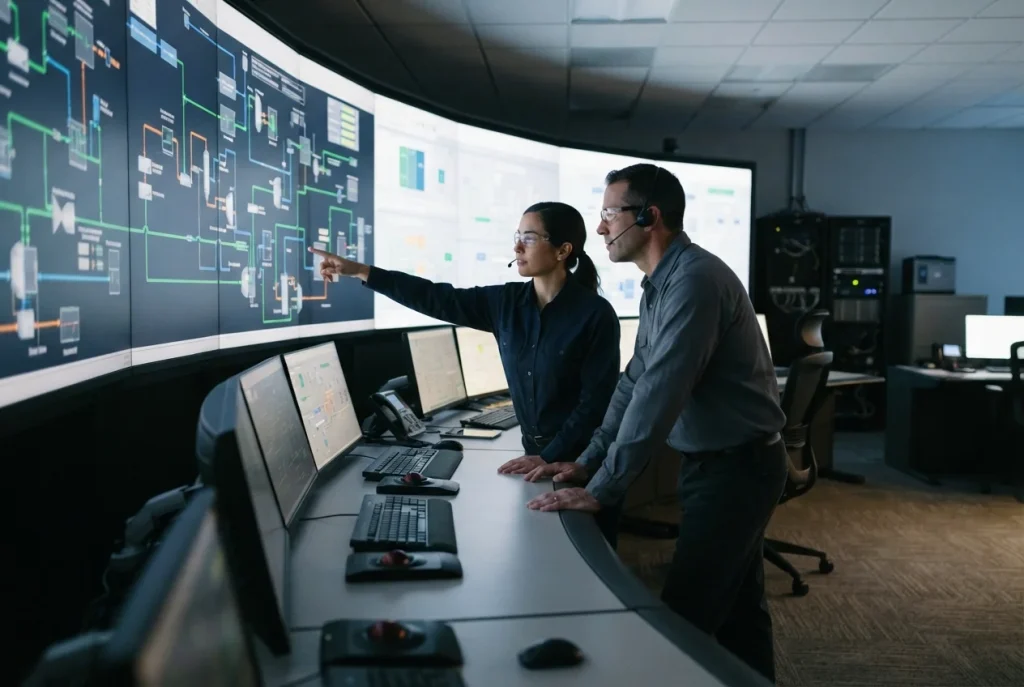
Simulation is especially useful when real-world training would be expensive or risky. Workers can practise responding to equipment failures or emergencies in a controlled environment, making mistakes while learning without the consequences they could have in an actual facility. The strongest employee upskilling programs for energy companies combine theory, simulation, and practical experience.
11. Online Learning and Microlearning
Not every employee can spend several weeks away from work attending a traditional course. Online learning offers flexibility: employees can access training through computers or mobile devices, and companies can provide learning without disrupting operations.
Microlearning takes this further by dividing larger subjects into short lessons. A 10-minute lesson might cover how to read a maintenance dashboard, identify a safety hazard, understand a production indicator, or use a digital inspection tool. Short lessons are easier to fit into busy schedules. However, online learning in employee upskilling programs for energy companies should not completely replace hands-on training where practical experience is essential.
12. Certification and Professional Development
Professional certifications give employees structured learning goals. Depending on their roles, workers may pursue certifications in project management, safety, quality management, industrial maintenance, inspection, data analysis, renewable energy, or process operations. The API inspector programs and OPITO offshore safety training mentioned above are examples of certifications tied to specific energy roles.
Companies can support professional development by paying for approved courses, providing study time, or creating internal career pathways. The key is to connect certifications with actual business and career needs. Training should not become a collection of certificates that employees never use.
13. How Companies Can Build an Effective Upskilling Strategy
A successful program usually starts with a simple question: what skills will our employees need in the next three to five years? From there, companies can follow six steps.
Step 1: Identify Skill Gaps
Compare current employee capabilities with the skills required for future projects and operations.
Step 2: Group Employees by Learning Needs
Different roles require different training. A field technician should not necessarily receive the same program as a senior engineer.
Step 3: Create Individual Learning Paths
Give employees clear learning objectives based on their current skills and career direction.
Step 4: Combine Different Learning Methods
Use online courses, workshops, mentoring, practical exercises, and certifications. Where in-house capacity is limited, outside support can help, as our industrial oil and gas maintenance outsourcing guide explains.
Step 5: Give Employees Opportunities to Apply Their Skills
Training becomes more valuable when employees can immediately use what they have learned.
Step 6: Review and Improve
Skills change over time. Review programs regularly and update them when technology, regulations, and business needs change.
14. Measuring the Success of Employee Upskilling Programs for Energy Companies
How do you know whether your employee upskilling programs for energy companies are working? Companies can track several indicators:
- Learning: course completion rates, certification achievements, and skill assessments.
- Career movement: internal promotions, internal mobility, and employee retention.
- Operations: productivity improvements, maintenance performance, and project performance.
- Safety: incident rates and near-miss reporting.
However, numbers alone do not tell the whole story. Companies should also ask employees whether the training helped them perform their jobs more effectively, and managers can observe whether new skills are being applied in real projects. The best programs create a connection between learning and measurable workplace outcomes.
15. The Future of Workforce Development in Energy
The future energy workforce will likely need a mixture of traditional expertise and emerging skills. Oil and gas operations will continue to require experienced technical professionals, while renewable energy, automation, artificial intelligence, data analytics, and digital systems create new learning requirements. This means employee development should not be a one-time event. It should become an ongoing process.
For energy companies, the workforce is a long-term investment. Equipment can be upgraded, software replaced, and facilities modernised, but experienced employees carry knowledge that cannot always be purchased instantly. Upskilling helps companies protect that knowledge while preparing employees for what comes next.
Conclusion
The best employee upskilling programs for energy companies are not necessarily the most expensive or complicated. They are the programs that connect employee skills with real operational needs.
From oil and gas technical training and safety programs to digital technology, artificial intelligence, renewable energy, leadership, and cross-training, companies have many ways to prepare their workforce. The most important step is to start with the skills employees need today and the skills they will need tomorrow. When companies invest in continuous learning, employees become more adaptable, productive, and prepared for a changing energy industry.
Frequently Asked Questions
What is an employee upskilling program?
An employee upskilling program is a structured learning initiative that helps workers develop new or improved skills for their current or future roles. In energy companies, this can include technical, digital, safety, leadership, and renewable energy training.
Why is upskilling important for oil and gas companies?
Upskilling helps oil and gas companies keep employee knowledge aligned with changing technologies, equipment, safety practices, and operational requirements. It can also help experienced workers develop digital and cross-functional capabilities.
What skills should energy companies prioritise?
The appropriate skills depend on the company’s operations. Common areas include technical engineering, safety, automation, data analytics, artificial intelligence, cybersecurity awareness, renewable energy, project management, and leadership.
Can online training be effective for energy workers?
Yes. Online training can provide flexible access to theoretical and digital subjects. However, practical subjects may require workshops, simulations, field exercises, or hands-on instruction in addition to online learning.
How can energy companies measure the success of upskilling programs?
Companies can measure training completion, certifications, skill assessments, internal promotions, productivity, safety performance, employee retention, and how effectively employees apply newly developed skills in their work.