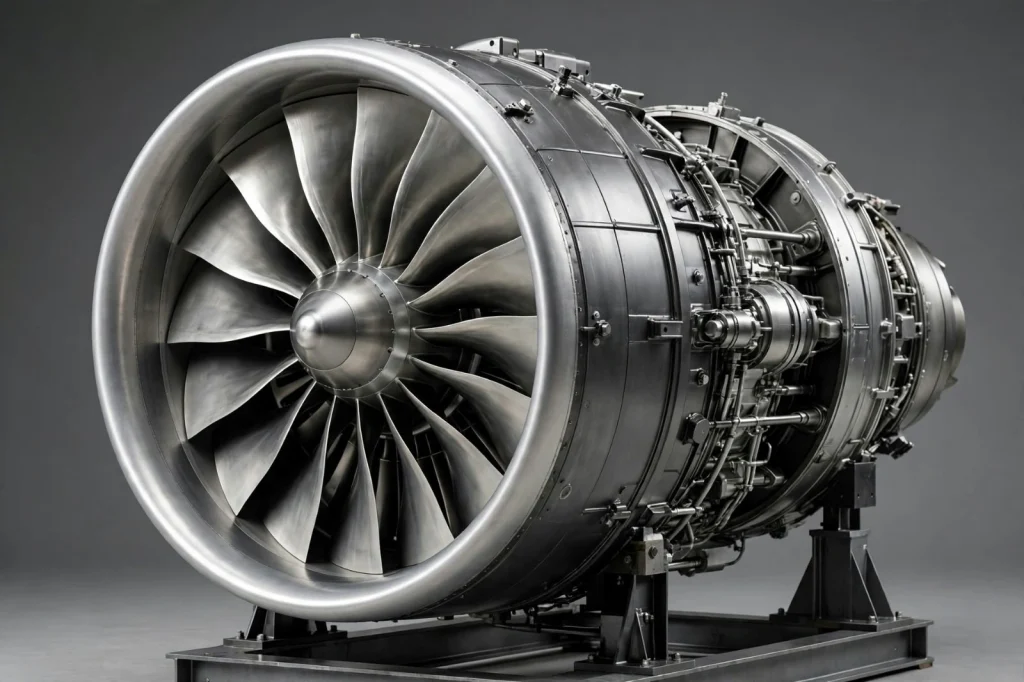
The Evolution of Turbine Engine Technology
Turbine engine technology runs from a steam toy in ancient Alexandria to wide-body jet engines crossing oceans, and it is one of modern engineering’s defining achievements. This is how it got here, and where it is heading.
Where the idea began
Turbine engine technology rests on a principle that is almost two thousand years old. Hero of Alexandria described the aeolipile, a hollow sphere that spun as steam escaped from two bent nozzles. It was a demonstration, not a machine, but it showed the reaction principle that jet engines still rely on.
The modern gas turbine was first outlined in 1791, when English inventor John Barber patented a design containing the main elements of a gas turbine: a compressor, a combustion chamber and a turbine. Materials and metallurgy of the day could not turn it into a working engine.
Key milestones in turbine engine technology
The breakthrough came just before the Second World War. Frank Whittle patented his jet engine concept in Britain in 1930 and ran his first prototype in 1937. At almost the same time, Hans von Ohain in Germany developed a similar engine that powered the Heinkel He 178, the first jet aircraft to fly, in August 1939.
- 1939 – Heinkel He 178 makes the first jet-powered flight.
- 1941 – Gloster E.28/39 flies with a Whittle engine.
- 1944 – Messerschmitt Me 262 and Gloster Meteor become the first operational jet fighters.
From turbojet to turbofan
Early turbojets were powerful but thirsty and loud, so turbine engine technology had to become more efficient. The next decades were about efficiency, and the engine family branched out:
- Turboprop: the turbine drives a propeller, ideal for lower speeds and shorter routes.
- Turbofan: a large fan pushes air around the engine core (the bypass flow), producing more thrust for far less fuel.
- Turboshaft: shaft power for helicopters, ships and power generation.
Early commercial turbofans such as the Rolls-Royce Conway in the late 1950s paved the way for the high-bypass engines of the 1960s and 1970s. Those engines made long-haul wide-body flights economical, and noticeably quieter.
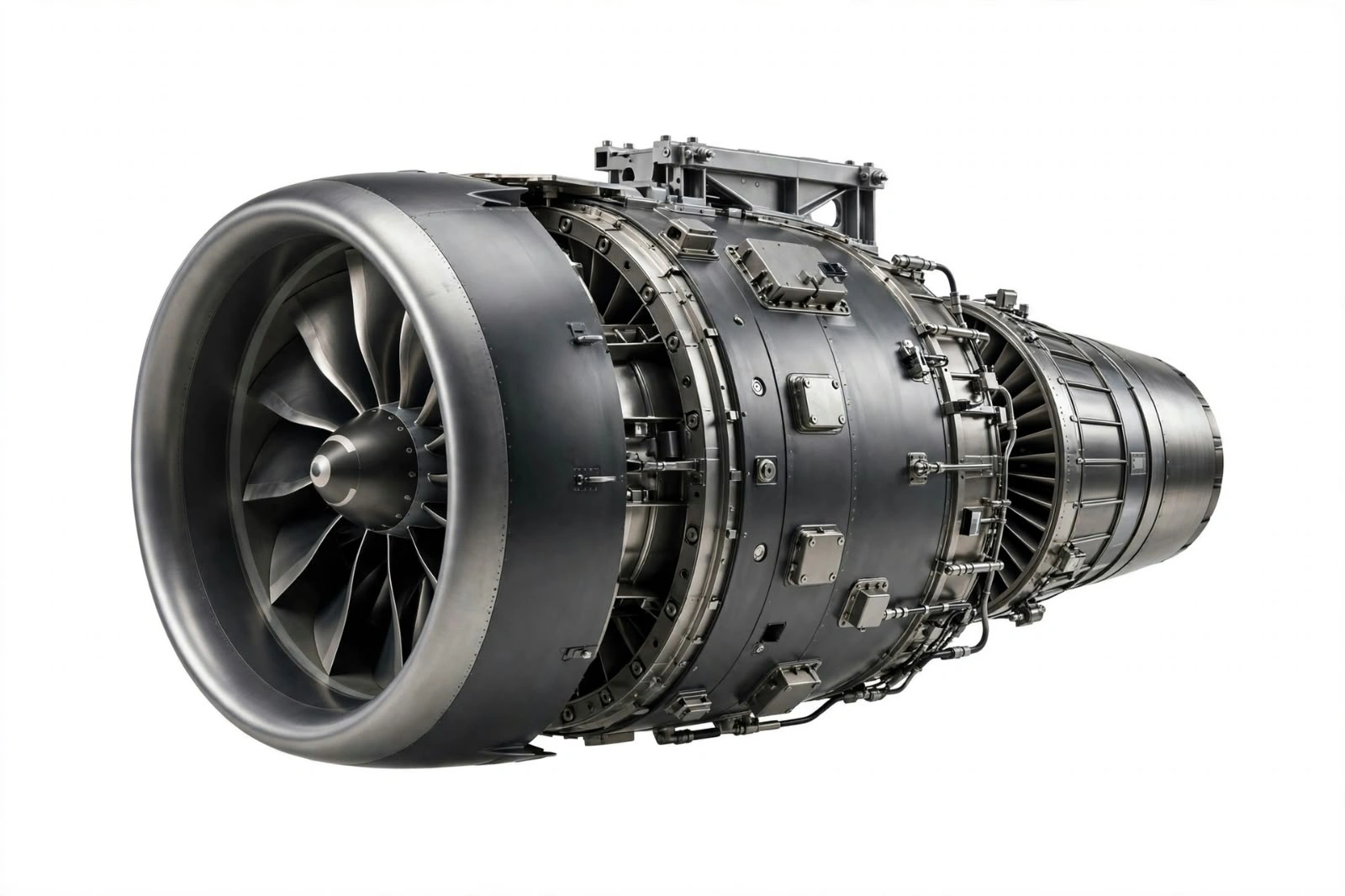
Materials and cooling: living above the melting point
Turbine engine efficiency rises with combustion temperature: the hotter the gas entering the turbine, the more work you extract. The problem is that today’s gas temperatures exceed the melting point of the metal blades that handle them.
Rounded, indicative values for illustration. Actual figures vary by engine and manufacturer.
Engineers closed the gap with a stack of innovations:
- Nickel-based superalloys that keep their strength under extreme heat and stress.
- Single-crystal blades, which remove grain boundaries and resist creep far better.
- Internal cooling through air passages and microscopic cooling holes in each blade.
- Thermal barrier coatings made from ceramics.
- Ceramic matrix composites (CMCs), light and heat-tolerant, now used in the latest engine generations.
For a basic visual explanation of how these engines work, see NASA Glenn’s turbine engine overview.
The digital era and additive manufacturing
Full Authority Digital Engine Control (FADEC) replaced mechanical-hydraulic controls and tunes engine performance in real time. Embedded sensors enable condition monitoring and predictive maintenance, which cuts disruptions and cost.
This shift toward connected, data-driven engineering is part of a wider trend, covered in our guide to Industry 4.0 implementation services for manufacturers. It is also changing the skills teams need, as we explain in how to build an engineering team ready for Industry 5.0.
Metal 3D printing has changed how parts are made too. A well-known example is the fuel nozzle of the LEAP engine, printed as a single piece instead of being assembled from many parts. The result is lighter and more durable.
New architectures: geared and very large turbofans
Two modern approaches stand out. The geared turbofan, such as Pratt & Whitney’s PW1000G family in commercial service since 2016, adds a reduction gearbox so the fan and turbine can each spin at their ideal speed. At the other end, very-high-bypass engines like the GE9X for the Boeing 777X rely on a huge fan, composite materials and CMCs for maximum efficiency.
Turbines beyond aviation
Turbine engine technology is not only for aircraft. In power generation, combined-cycle plants pair a gas turbine with a steam turbine and have passed 60% efficiency, among the highest of any fossil-fuelled technology. Turbines also drive ships, gas pipeline compressors and heavy industry. For a closer look at how fluid density affects compressor and fan performance, read our turbomachinery design briefing on real-gas solvers, and see the significance of fans in turbomachinery for the role fans play.
What comes next: cleaner turbines
Decarbonization is now the central challenge. Current work includes:
- Sustainable aviation fuel (SAF), which can already be blended with conventional jet fuel in set proportions without redesigning the engine.
- Hydrogen as a turbine fuel, with open questions around storage, safety and combustion.
- Hybrid-electric architectures and open rotor concepts for higher efficiency.
- Low-NOx combustors and further noise reduction.
Conclusion: the future of turbine engine technology
From Hero’s steam sphere to modern turbofans with single-crystal blades and 3D-printed parts, the story of turbine engine technology is one of steady progress in materials, aerodynamics and engineering ingenuity. Making turbine power cleaner without sacrificing reliability may well be its most interesting chapter yet.
Frequently asked questions
What is turbine engine technology?
It is the science and engineering of engines that extract energy from a flow of hot gas or steam by spinning a turbine. Applications range from jet engines and helicopters to power plants and ships.
Who invented the jet engine?
Two engineers developed it independently. Frank Whittle in Britain patented the concept in 1930 and ran a prototype in 1937, while Hans von Ohain in Germany built an engine that powered the first jet flight, the Heinkel He 178, in 1939.
What is the difference between a turbojet and a turbofan?
A turbojet produces thrust almost entirely from hot exhaust gas. A turbofan adds a large fan that moves extra air around the engine core, which gives more thrust per unit of fuel and makes the engine quieter. Most modern airliners use turbofans.
Why don’t turbine blades melt if the gas is hotter than their melting point?
Several measures work together: nickel superalloys, single-crystal blade structure, cooling air flowing through internal passages and tiny surface holes, and ceramic thermal barrier coatings. Cooler air forms a protective film over the blade surface.
What is a geared turbofan?
It is a turbofan with a reduction gearbox between the fan and the turbine that drives it. The gearbox lets the large fan turn slowly while the turbine spins fast, and each runs closer to its most efficient speed.
What are ceramic matrix composites (CMCs)?
CMCs are ceramic materials reinforced with fibres. They are lighter than metal alloys and tolerate very high temperatures, so they need less cooling air and improve engine efficiency.
What is sustainable aviation fuel (SAF)?
SAF is jet fuel made from sources such as waste oils, agricultural residues or synthetic processes, with lower lifecycle carbon emissions than fossil jet fuel. Approved SAF can be blended with conventional fuel in set proportions and used in existing engines.
Can turbines run on hydrogen?
Hydrogen-fuelled turbines are under active development and testing, but they are not yet standard. Storage, safety and combustion control remain the main engineering challenges, particularly for aircraft.
Are gas turbines used outside aviation?
Yes. They generate electricity in power plants, often in combined-cycle configurations, and they drive ships, gas pipeline compressors and industrial equipment.