Abstract
Pipeline inspection companies play a central role in integrity management, which has shifted from a periodic compliance activity to a continuous, risk-informed discipline. Selecting among them is a technical and commercial decision with direct consequences for safety, environmental performance, and lifecycle cost.
This article compares eight widely recognised providers of oil and gas pipeline inspection and integrity services: ROSEN Group, NDT Global, T.D. Williamson, Baker Hughes, PIPECARE Group, Applus+, Intertek, and MISTRAS Group.
They are assessed against eight weighted criteria derived from established integrity-management standards and grouped into two categories: in-line inspection (ILI)-centred specialists, and integrity, non-destructive testing (NDT), and testing-inspection-certification (TIC) providers.
Because publicly available data do not support a strict ordinal ranking of pipeline inspection companies with different business models, results are presented as category-based assessments with explicit scope and limitations. The article concludes with a decision framework that operators can adapt to their own threat profile.
Table of Contents
Introduction
Onshore and offshore pipelines carry crude oil, refined products, natural gas, and, increasingly, hydrogen blends and carbon dioxide. A significant share of the installed network has operated for decades and is exposed to corrosion, fatigue, mechanical damage, ground movement, and coating deterioration. Undetected defects can lead to leaks, ruptures, production losses, regulatory penalties, and environmental harm.
Integrity management programmes address these risks by combining threat identification, inspection, assessment, and mitigation. Within that cycle, the choice among pipeline inspection companies influences two outcomes that are difficult to correct later: the quality of the underlying data, and the quality of the engineering judgement applied to it. Poor sizing accuracy can lead to unnecessary excavations or, more seriously, to missed critical defects.
This article addresses three questions:
- Which technologies underpin modern pipeline inspection, and what are their limitations?
- How do prominent pipeline inspection companies differ in capability, scope, and suitability for different pipeline conditions?
- How should an operator structure a defensible provider-selection process?
- Regulatory and Technical Context
Regulatory and Technical Context
Inspection practice is shaped by a layered framework of regulations and consensus standards. In the United States, pipeline safety requirements for gas and hazardous liquid pipelines are set out in 49 CFR Parts 192 and 195, administered by PHMSA.
Industry standards provide the technical basis for integrity programmes, including API RP 1160 for hazardous liquid pipelines and ASME B31.8S for gas pipelines. API Standard 1163 addresses the qualification of in-line inspection systems, AMPP/NACE SP0102 provides guidance on ILI practice, and the Pipeline Operators Forum (POF) specifications are widely used to define ILI performance reporting. Defect acceptability is commonly evaluated using fitness-for-service methodologies such as API 579-1/ASME FFS-1.
Operators outside the United States apply national regulators’ requirements alongside ISO and DNV standards. A provider’s familiarity with the applicable framework is therefore a practical selection criterion, not merely a matter of reputation.
Inspection Technologies
No single technology addresses every threat. Table 1 summarises the principal methods and their typical roles.
Table 1. Principal pipeline inspection technologies
| Technology | Primary threats addressed | Typical application | Key limitations |
|---|---|---|---|
| Magnetic flux leakage (MFL) | Metal loss, corrosion | In-line inspection of ferromagnetic pipe | Less effective for tight, axially oriented crack-like features |
| Ultrasonic testing (UT), in-line | Wall thickness, metal loss, cracks | Liquid pipelines (liquid couplant available) | Gas pipelines typically require a liquid slug or alternative method |
| Electromagnetic acoustic transducer (EMAT) | Crack-like defects, stress corrosion cracking | Gas and liquid pipelines where couplant is impractical | Tool availability and data interpretation maturity vary by diameter and vendor |
| Geometry/calliper and inertial mapping (IMU) | Dents, ovality, wrinkles, bending strain, pipeline movement | Baseline and repeat surveys | Does not directly characterise metal loss |
| External NDT (UT, PAUT, TOFD, RT, MT/PT, ECT) | Weld flaws, surface cracks, local wall loss | Facilities, excavations, construction inspection | Point or local coverage; not a substitute for full-length ILI |
| Continuous monitoring (acoustic emission, distributed fibre-optic sensing, leak detection systems) | Active damage, leaks, third-party interference, ground movement | Permanent monitoring of critical segments | Detects change or events rather than providing a full defect inventory |
| Remote platforms (UAV, ROV, AUV) | Right-of-way conditions, coating damage, subsea condition | Above-ground and offshore assets | Surface or visual-level information unless combined with NDT payloads |
Two cross-cutting issues deserve emphasis. First, unpiggable pipelines, those with restricted bends, diameter changes, or absent launch and receive facilities, may require specialised tools or alternative assessment methods. Second, emerging products change the threat profile: hydrogen service raises concerns about embrittlement and crack growth, while carbon dioxide service introduces distinct corrosion and fracture-control considerations. Inspection strategies should be validated for the intended service rather than assumed transferable.
Methodology
4.1 Scope and provider set
The eight pipeline inspection companies were selected for their international presence and their recurring appearance in industry market reviews of pipeline inspection and integrity services. The list is not exhaustive. Other credible providers, including SGS, DNV, Bureau Veritas, and Quest Integrity, are outside the scope of this edition and may be added in future updates.
4.2 Provider categories
Because business models differ materially,pipeline inspection companies are assessed in two categories rather than on a single scale:
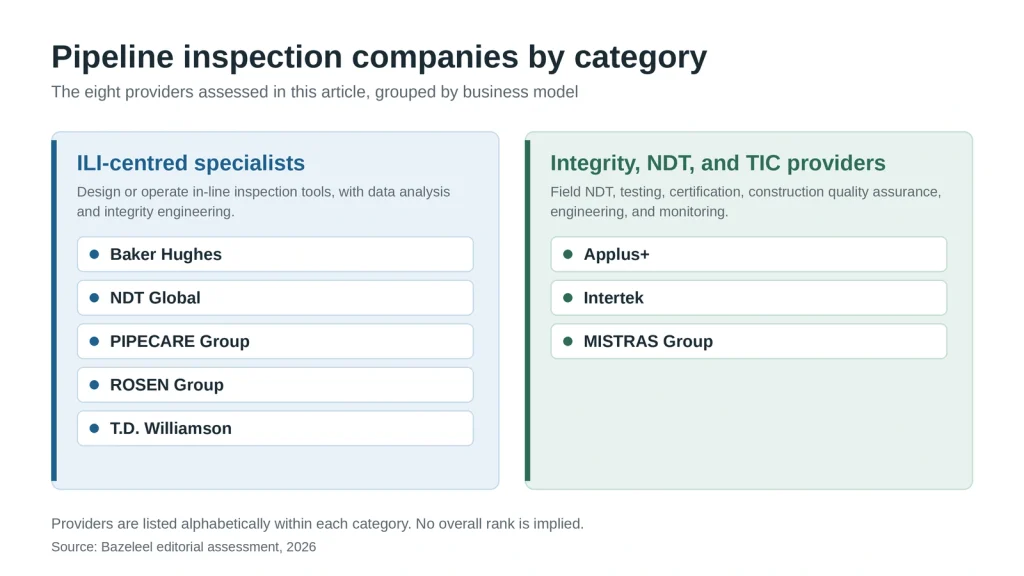
- Category A: ILI-centred specialists. Organisations that design or operate in-line inspection tools and offer associated data analysis and integrity engineering.
- Category B: Integrity, NDT, and TIC providers. Organisations whose core offering is field NDT, testing, certification, construction quality assurance, engineering consulting, or monitoring, with ILI delivered either in a limited form or not as the primary service.
Comparing a manufacturer of high-resolution ILI tools directly with a laboratory-and-certification organisation would obscure the fact that they often serve different stages of the same programme.
4.3 Evaluation criteria and weighting
Criteria were derived from the integrity-management and ILI-qualification practices referenced in Section 2. The weights below reflect the editorial team’s judgement of relative importance for a typical transmission-pipeline operator and should be adjusted for specific assets.
Table 2. Evaluation criteria and indicative weights
| Criterion | Indicative weight | Assessment focus |
|---|---|---|
| Technical capability (ILI and NDT) | 25% | Breadth and fitness of methods for the principal threats |
| Data quality and engineering analysis | 20% | Sizing accuracy disclosure, validation practice, fitness-for-service and growth analysis |
| Health, safety, and quality systems | 15% | Safety management, certifications, incident transparency |
| Standards and regulatory support | 10% | Familiarity with API, ASME, ISO, DNV, and national requirements |
| Global reach and mobilisation | 10% | Regional presence, field resources, response capability |
| Digital and analytical capability | 10% | Data integration, trending of repeat runs, validated analytics |
| Innovation and research | 5% | Documented technical development and publications |
| Track record | 5% | Evidence of comparable projects |
| Total | 100% |
4.4 Evidence base and rating scale
Assessments draw on publicly available company information, published technical papers, and the standards listed in the references. Each provider is rated Strong, Moderate, or Not a primary focus for each criterion. These are qualitative editorial judgements. They are not measurements of tool performance.
4.5 Limitations
The study has four principal limitations. Independent, comparable performance data (such as probability of detection and sizing tolerances for specific tools) are generally held by operators and vendors and are not public. Company statements are promotional by nature and were not independently audited. Capability varies by region, pipe diameter, and product, which a global summary cannot capture. Finally, rankings of dissimilar pipeline inspection companies are inherently context-dependent. Readers should treat the results as a screening aid, not a procurement decision.
Comparative Assessment
Within each category, pipeline inspection companies are listed alphabetically. No overall ordinal rank is implied.
5.1 Category A: ILI-centred specialists
Baker Hughes. A global energy technology company whose pipeline inspection services sit within a broader portfolio of digital, monitoring, and engineering offerings. Its principal strength is integration with condition-monitoring and asset-performance software across upstream, midstream, and downstream assets. Consideration: the breadth of the portfolio means operators should confirm the availability of dedicated pipeline-integrity resources and specific tool types in their region.
NDT Global. A Germany-based specialist known for ultrasonic in-line inspection and crack detection. Its focus is most relevant where crack-like threats, such as stress corrosion cracking and seam-weld defects, dominate the integrity case. Consideration: a narrower service scope than diversified providers; operators needing facility NDT or construction inspection will require additional contractors.
PIPECARE Group. An inspection and integrity provider that, according to its own materials, emphasises complex and difficult-to-inspect pipelines, including piggability-constrained assets and offshore lines. Consideration: operators should request project references and tool specifications for their specific geometry, and verify regional presence.
ROSEN Group. Founded in the early 1980s by Hermann Rosen, the group designs and operates a wide range of ILI technologies, including MFL, ultrasonic, EMAT, geometry, and inertial mapping, together with integrity engineering and software. Its profile suits large and technically complex systems with multiple threats. Consideration: the breadth and scale of its programmes may exceed the needs, or the budget, of small-bore or low-consequence gathering networks.
T.D. Williamson (TDW). Founded in 1920 in Tulsa, Oklahoma, TDW combines in-line inspection and pigging services with pipeline intervention capabilities, notably hot tapping, line stopping, and isolation. This combination is valuable where inspection findings must be followed by repair without prolonged shutdown. Consideration: operators should confirm tool availability for their diameters and the specific threat to be assessed.
5.2 Category B: Integrity, NDT, and TIC providers
Applus+. A Spain-headquartered testing, inspection, and certification group with NDT, engineering, construction quality assurance, and subsea inspection capabilities. It is well suited to projects that span construction, commissioning, and operation under independent oversight. Consideration: in-line inspection of long transmission lines is not its primary positioning; operators should verify the scope of its ILI offering.
Intertek. A global TIC organisation with laboratories, field NDT, materials and failure analysis, and construction inspection services. Its laboratory capability is particularly relevant for root-cause investigation and materials qualification, including assessments for new energy carriers. Consideration: it is generally engaged for assurance and testing rather than as a manufacturer of ILI tools.
MISTRAS Group. A US-headquartered asset-protection provider with strengths in NDT, acoustic emission, permanent monitoring, and engineering services. Continuous monitoring of selected high-risk segments and integrated NDT for midstream facilities are its clearest differentiators. Consideration: operators seeking high-resolution full-length ILI for large transmission systems will typically pair it with a specialist from Category A.
5.3 Summary matrix
Table 3. Editorial capability summary (qualitative; based on public information)
| Provider | Category | Principal strength | Best suited for | Main consideration |
|---|---|---|---|---|
| Baker Hughes | A | Integration with digital monitoring and broad energy portfolio | Multi-asset operators seeking integrated analytics | Confirm regional pipeline-integrity resources |
| NDT Global | A | Ultrasonic ILI and crack detection | Crack, SCC, and seam-weld threats | Narrower service scope |
| PIPECARE Group | A | Difficult and unpiggable pipelines | Ageing or constrained assets | Verify references and regional presence |
| ROSEN Group | A | Multi-technology ILI with integrity engineering | Large, multi-threat transmission systems | May be over-scoped for small networks |
| T.D. Williamson | A | ILI combined with intervention and isolation | Inspect-and-repair programmes | Confirm tool availability by diameter |
| Applus+ | B | NDT, construction QA, subsea inspection | Construction and lifecycle assurance | Verify ILI scope |
| Intertek | B | Laboratory, materials, and certification | Failure analysis and independent verification | Not an ILI tool specialist |
| MISTRAS Group | B | Acoustic emission and continuous monitoring | Monitoring and facility NDT | Pair with ILI specialist for transmission lines |
Selection Framework for Operators
A defensible process for choosing among pipeline inspection companies matches the provider to the assetrather than to brand recognition. The following sequence is recommended.
- Define the threat profile. Identify the dominant mechanisms (corrosion, cracking, mechanical damage, ground movement) from prior inspection data, operating history, and a formal threat assessment.
- Define constraints. Record diameter, length, wall thickness, product, pressure, geometry, launcher and receiver availability, and offshore or onshore setting.
- Request technical evidence. Ask each provider for tool specifications, declared detection and sizing performance at a stated confidence level, and evidence of qualification consistent with API 1163 and POF practice.
- Examine validation practice. Request details of how in-line results are compared with field measurements from excavations, and how discrepancies are handled.
- Assess post-inspection engineering. Confirm the capability to perform fitness-for-service assessment, crack and corrosion growth analysis, and remaining-life estimation.
- Review safety and quality records. Examine safety management systems, certifications, and incident history.
- Check regional capability. Verify mobilisation time, local regulatory knowledge, and emergency-response support.
- Evaluate lifecycle cost. Compare total cost, including data quality, repeatability across runs, and the cost of a missed or misclassified defect, rather than the unit inspection price alone.
Table 4. Indicative matching of need to provider type
| Primary need | Provider type most relevant |
|---|---|
| Crack-like threats or seam-weld defects | ILI specialists with ultrasonic or EMAT capability |
| Piggability constraints | Providers with specialised or alternative inspection tools |
| Inspection followed by repair without shutdown | Providers combining ILI with intervention services |
| Construction quality assurance and commissioning | TIC and NDT organisations |
| Root-cause failure investigation | Laboratory-equipped TIC organisations |
| Continuous monitoring of high-risk segments | Monitoring and acoustic-emission specialists |
Teams can convert the criteria in Table 2 into a weighted matrix, increasing the weight of crack detection for a pipeline susceptible to stress corrosion cracking, or of piggability expertise for older networks with complex geometry.
Emerging Technologies and Their Maturity
Several developments are reshaping practice, although their maturity varies and claims should be validated before reliance.
- Machine learning in data analysis. Automated anomaly detection and classification can accelerate analysis of large datasets. Performance depends on training data quality and should be benchmarked against manual or verified results.
- Digital twins and integrated platforms. Combining inspection results, operating data, and maintenance records supports trending across repeat runs and risk-based prioritisation, provided data are consistent and traceable.
- Distributed fibre-optic sensing and acoustic monitoring. These systems offer continuous detection of leaks, third-party interference, and ground movement over long distances, complementing rather than replacing periodic ILI.
- Unmanned aerial and underwater vehicles. UAVs support right-of-way and above-ground surveys, and ROVs and AUVs support subsea inspection, improving safety and coverage when equipped with appropriate sensors.
- New energy carriers. Repurposing pipelines for hydrogen or carbon dioxide requires material and integrity reassessment, including inspection methods validated for the relevant degradation mechanisms.
The common point is that technology adds value when it improves data quality and decision-making. A longer technology list is not, in itself, evidence of better performance.
Conclusion
There is no universally best choice among pipeline inspection companies. ILI-centred specialists and TIC/NDT organisations address different stages of the integrity cycle, and the appropriate choice depends on the pipeline’s threat profile, physical constraints, regulatory environment, and long-term programme objectives. Operators are best served by requiring transparent performance evidence, understanding how results are validated, and ensuring that post-inspection engineering is as rigorous as the inspection itself. Future editions of this assessment will extend the provider set and incorporate any verifiable performance data that become available.
Frequently Asked Questions
What do pipeline inspection companies do?
It assesses pipeline condition using in-line inspection and non-destructive testing to identify corrosion, cracks, dents, and weld flaws, and typically supports engineering assessment of whether defects require monitoring or repair.
How often should a pipeline be inspected?
There is no universal interval. Frequency depends on regulation, pipeline age, material, product, corrosion or crack growth rates, and consequence of failure. Operators increasingly use risk-based approaches informed by trending of repeat inspection data.
What are unpiggable pipelines?
These are lines that cannot accommodate conventional in-line tools due to geometry, restrictions, or missing launch and receive facilities. Specialised tools or alternative assessment methods are used.
Is the lowest-priced inspection the best choice?
Not necessarily. Data quality, repeatability, and engineering support strongly influence lifecycle cost, including the cost of a missed defect.
Disclosure
[Insert statement describing whether Bazeleel has any commercial relationship, sponsorship, or affiliation with any provider discussed. If none, state: “Bazeleel has no commercial relationship with the pipeline inspection companies assessed in this article
References
- API RP 1160, Managing System Integrity for Hazardous Liquid Pipelines. American Petroleum Institute.
- ASME B31.8S, Managing System Integrity of Gas Pipelines. American Society of Mechanical Engineers.
- API Standard 1163, In-Line Inspection Systems Qualification. American Petroleum Institute.
- AMPP/NACE SP0102, In-Line Inspection of Pipelines. Association for Materials Protection and Performance.
- Pipeline Operators Forum (POF), Specifications and Requirements for In-Line Inspection of Pipelines.
- API 579-1/ASME FFS-1, Fitness-for-Service.
- U.S. Code of Federal Regulations, Title 49, Parts 192 and 195. Pipeline and Hazardous Materials Safety Administration (PHMSA).
- Provider websites and published technical materials: ROSEN Group, NDT Global, T.D. Williamson, Baker Hughes, PIPECARE Group, Applus+, Intertek, MISTRAS Group.
Note: cite the specific edition or year of each standard used.