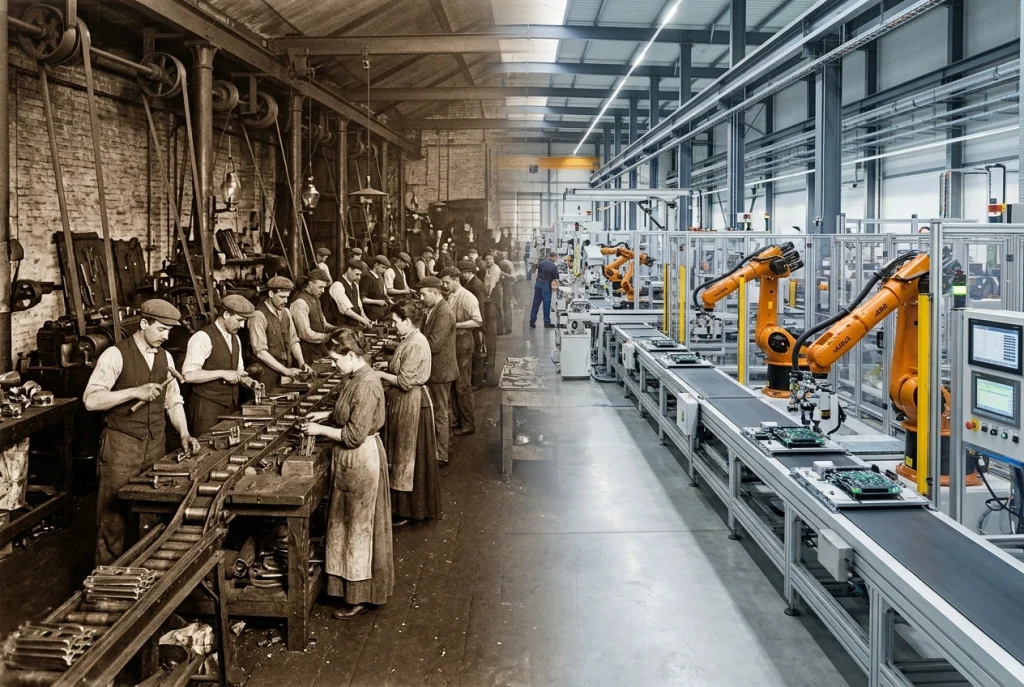
The history of industrial engineering is a story of people searching for better ways to organise work. The discipline took shape in the late 19th and early 20th centuries, but its basic ideas, such as planning, coordination, and efficient use of resources, are much older. This article walks through eight milestones in the history of industrial engineering, from ancient building projects to AI-powered factories.
New to the subject? Start with our beginner guide: what is industrial engineering.
Table of Contents
1. Early Foundations in the History of Industrial Engineering
Industrial engineering did not exist as a profession in ancient times, but many early civilisations applied similar thinking. The ancient Egyptians organised labour, materials, and schedules to build massive pyramids. The Romans built road networks, water systems, and military supply lines that demanded detailed planning. In China, large projects such as the Great Wall required the coordination of workers, materials, and transport.
These civilisations lacked modern engineering tools and software, yet they understood that planning, organisation, and resource allocation determine whether large projects succeed. Those principles remain central to the field.
2. The Industrial Revolution: A Turning Point
The Industrial Revolution, which began in the late 18th century, marked the real start of industrial engineering. Before it, most goods were made by skilled craftsmen in small workshops. Steam-powered machinery changed that: factories grew larger, output rose sharply, and thousands of workers were brought together under one roof.
Greater scale brought new problems. Factory owners struggled with:
- Inefficient workflows and poor factory layouts.
- Long production times and low worker productivity.
- Inconsistent product quality.
- High production costs.
These problems created demand for people who could study manufacturing systems and develop better ways of working. That demand gave rise to industrial engineering.
3. Frederick Winslow Taylor and Scientific Management
Frederick Winslow Taylor is often called the father of scientific management and is regarded as one of the founders of the discipline. In the late 1800s he observed that factories relied on tradition rather than measurement. Workers did the same job in different ways, producing uneven results and wasted effort.
Taylor introduced scientific management, which uses observation, measurement, and experimentation to find the most efficient way to perform a task. His main ideas were:
- Standardising work methods.
- Measuring task performance.
- Selecting and training workers systematically.
- Separating planning from execution.
- Improving productivity through data rather than guesswork.
Some of his methods were later criticised for putting efficiency ahead of workers’ needs. Even so, his insistence on measuring before improving laid the foundation for modern industrial engineering.
4. Frank and Lillian Gilbreth: Improving Human Performance
Frank and Lillian Gilbreth pioneered motion study. Instead of only asking how fast people could work, they studied how workers moved and which motions wasted time and energy. Their research led to simpler work methods, less fatigue, better-designed workplaces, safer tasks, and higher productivity without overworking employees.
Lillian Gilbreth also emphasised psychology and employee well-being, which pushed the field toward a more human-centred approach. Many ergonomic principles used today trace back to their work. The related technique of time and motion study is still taught and used.
5. Henry Ford and the Moving Assembly Line
In 1913, Henry Ford introduced a continuously moving assembly line for the Model T. Instead of workers moving between workstations, the product moved from one station to the next while each employee performed a specific task. Commonly cited figures say the time to assemble a chassis fell from roughly twelve hours to about an hour and a half.
The assembly line offered higher production rates, lower manufacturing costs, consistent quality, simpler worker training, and cheaper products for consumers. It showed how much a well-designed system can change industrial performance and inspired many of the process optimisation techniques used today.
6. Growth of Industrial Engineering in the 20th Century
As industries expanded, industrial engineering moved beyond manufacturing. Engineers began applying optimisation methods to:
- Healthcare operations and transportation systems.
- Warehouse management and military logistics.
- Retail operations and construction projects.
- Banking and financial services.
Important methodologies emerged during this period: operations research, quality control, inventory management, statistical process control, systems engineering, and human factors engineering. They let engineers tackle complex business problems with mathematical models, probability, and statistics.
7. Lean Manufacturing and Six Sigma
By the late 20th century, organisations wanted even more effective ways to improve efficiency and quality, and two approaches spread widely.
Lean manufacturing, which grew out of the Toyota Production System, focuses on removing activities that add no value for the customer. It helps businesses cut inventory, shorten production times, and improve customer satisfaction.
Six Sigma, which originated at Motorola in the 1980s, is a data-driven method for reducing variation and eliminating defects by finding root causes with statistics. Together, Lean and Six Sigma became standard tools for industrial engineers. You can see how they work in practice in our guide to industrial engineering tools and techniques.
8. Industrial Engineering in the Digital Age
The 21st century has changed industrial engineering through rapid advances in digital technology. Engineers now work with:
- Artificial intelligence and machine learning.
- Big data analytics and cloud computing.
- Internet of Things (IoT) sensors.
- Automation and robotics.
- Digital twins and smart manufacturing systems.
Instead of relying only on manual observation, engineers can collect real-time data from connected machines, simulate whole production systems, and predict equipment failures before they occur. For examples, see our guides to Industry 4.0 implementation services and industrial IoT solutions. Looking ahead, the profession will focus on smart factories, sustainable manufacturing, resilient supply chains, human-robot collaboration, and the circular economy.
Timeline of Industrial Engineering at a Glance
| Era | Milestone | Key contribution |
|---|---|---|
| Ancient world | Pyramids, Roman roads, Great Wall | Large-scale planning and logistics |
| Late 1700s | Industrial Revolution | Factories and the need for systematic management |
| Late 1800s | Frederick Winslow Taylor | Scientific management and work measurement |
| Early 1900s | Frank and Lillian Gilbreth | Motion study and human factors |
| 1913 | Henry Ford | Moving assembly line |
| 1900s | Operations research and quality control | Mathematical and statistical methods |
| Late 1900s | Lean and Six Sigma | Waste elimination and defect reduction |
| 2000s onward | AI, IoT, automation | Real-time data and smart systems |
Why the History of Industrial Engineering Still Matters
The history of industrial engineering explains why the field works the way it does. Taylor taught engineers to measure before improving. The Gilbreths showed that people are at the centre of every system. Ford demonstrated the power of flow. Lean and Six Sigma turned waste and variation into things that can be managed. Today’s digital tools build on those same ideas.
Conclusion
The history of industrial engineering reflects humanity’s ongoing pursuit of better ways to work. From ancient monuments and the factories of the Industrial Revolution to AI-powered production systems, the discipline has adapted to changing technological and economic demands. Pioneers such as Taylor, the Gilbreths, and Ford transformed how organisations think about productivity, quality, and process improvement.
To see where the field is today, read the full beginner guide to industrial engineering and learn about the benefits of industrial engineering.
Frequently Asked Questions
Who is the father of industrial engineering?
Frederick Winslow Taylor is usually called the father of scientific management and is often credited as a founder of industrial engineering, alongside Frank and Lillian Gilbreth.
When did the history of industrial engineering begin?
Its roots go back to ancient planning and logistics, but it became a formal discipline during the Industrial Revolution and the late 19th century, when factories needed systematic methods to improve productivity.
What did the Gilbreths contribute?
They pioneered motion study, which analyses how workers move, and promoted workplace design that reduces fatigue, improves safety, and considers employee well-being.
How did Ford’s assembly line influence industrial engineering?
It showed that a well-designed flow of work can sharply cut production time and cost, inspiring later process optimisation methods such as line balancing and Lean manufacturing.