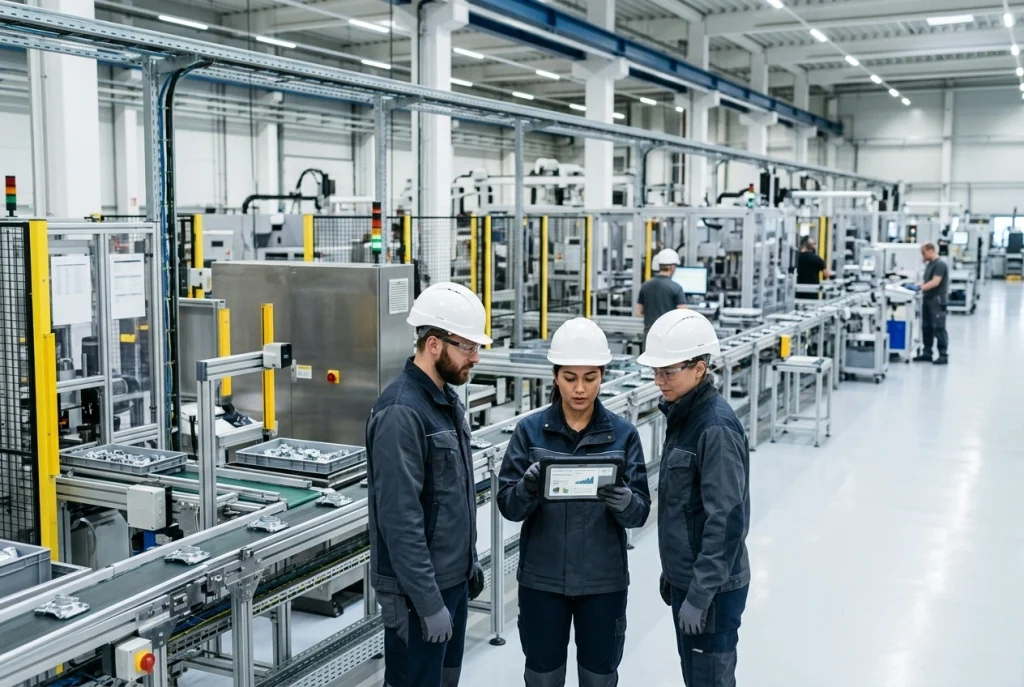
The benefits of industrial engineering reach businesses, employees, customers, and society. By improving processes, optimising resources, and solving operational problems, industrial engineers help organisations perform better without sacrificing quality or safety. In a competitive market where companies must deliver better products, faster service, and lower costs, those benefits are more valuable than ever.
This article explains why industrial engineering is important and lists 10 proven benefits with examples. If you are new to the topic, start with our beginner guide: what is industrial engineering.
Why Is Industrial Engineering Important?

Table of Contents
Every organisation depends on a chain of connected processes. If one part is inefficient, it can create delays, raise costs, reduce quality, and harm customer satisfaction. Imagine rush-hour traffic: even if every car is in perfect condition, congestion forms when the overall flow is badly managed. Industrial engineering improves the entire system so that everything flows smoothly, efficiently, and safely.
As competition grows, organisations compete not only on price but also on quality, speed, flexibility, and sustainability. Industrial engineers help make all of these goals achievable.
Demand for these skills is growing. The U.S. Bureau of Labor Statistics projects employment of industrial engineers to grow about 12% from 2025 to 2035, much faster than the average for all occupations.
10 Benefits of Industrial Engineering
1. Increases Productivity
Productivity measures how efficiently time, labour, equipment, and materials produce goods or services. Industrial engineers find unnecessary activities, delays, and bottlenecks and redesign workflows to remove them. For example, rearranging a production line so workers walk less can add thousands of products a year without extra staff or machines.
2. Reduces Operational Costs
Industrial engineering lowers cost by removing inefficiency instead of cutting corners. Savings typically come from less material waste, less equipment downtime, lower inventory, better labour efficiency, lower energy use, better transport routes, and improved production planning. Lower costs improve profit and leave room to invest in innovation.
3. Improves Product and Service Quality
Industrial engineers build quality control systems that monitor processes, find defects early, and prevent repeat problems. In service industries, quality means shorter waits, clearer communication, and consistent procedures. Better quality means fewer complaints, fewer returns, lower warranty costs, and a stronger reputation.
4. Eliminates Waste
Waste uses resources without creating value. Industrial engineers look for overproduction, waiting, excess inventory, unnecessary transport, unnecessary movement, defects, overprocessing, and underused employee skills. Removing them improves efficiency, reduces cost, and lowers environmental impact.
5. Enhances Workplace Safety
Industrial engineers evaluate layouts, equipment, and work methods to find hazards. Common improvements include ergonomic workstations, better equipment placement, safer procedures, better facility layouts, preventive maintenance, and risk assessment. Safer workplaces mean fewer injuries, better morale, less absenteeism, and lower insurance and healthcare costs.
6. Improves Employee Satisfaction
Well-designed systems reduce stress, repetitive work, and frustration. Industrial engineers contribute by improving communication, reducing physical strain, balancing workloads, writing clear procedures, and creating organised workplaces. Engaged employees are generally more productive and more likely to stay.
7. Supports Better Decision-Making
Organisations collect huge amounts of operational data, but data only helps when it is analysed. Industrial engineers use statistics, analytics, mathematical models, and simulation to turn it into insight. This lets managers forecast demand, plan production, allocate resources, track performance, and set improvement priorities with less guesswork.
8. Strengthens Customer Satisfaction
Customers expect fast delivery, high quality, reliable service, and fair prices. Industrial engineering helps meet those expectations through shorter delivery times, better order accuracy, faster customer service, higher product availability, and efficiency that keeps prices competitive. Satisfied customers return and recommend the company to others.
9. Promotes Sustainability
Industrial engineering helps organisations reduce environmental impact while staying profitable by cutting material waste and energy consumption, improving recycling, optimising transport, lowering carbon emissions, and supporting circular economy practices. These improvements benefit both the business and society.
10. Supports Innovation, Flexibility, and Digital Transformation
Industrial engineers help businesses adopt technologies such as artificial intelligence, automation, robotics, IoT, cloud computing, and digital twins without disrupting operations. They also design flexible processes that adapt to changing demand, supply disruptions, and customer preferences. See how this works in our guides to Industry 4.0 implementation services and industrial IoT solutions.
Benefits of Industrial Engineering Across Industries
| Industry | Typical benefits |
|---|---|
| Manufacturing | Higher production efficiency, better quality control, lower manufacturing cost |
| Healthcare | Shorter patient waits, smoother hospital operations, better resource use |
| Logistics | Faster deliveries, optimised warehouses, lower transport cost |
| Retail | More accurate inventory, better customer experience, efficient order fulfilment |
| Technology | Streamlined processes, stronger project management, better operational performance |
| Government | More efficient public services, better resource allocation, simpler administration |
| Energy and oil and gas | Better maintenance planning, less downtime, improved asset reliability |
For an energy-sector example, see our industrial oil and gas maintenance outsourcing guide.
The Long-Term Value of Industrial Engineering
Perhaps the greatest benefit of industrial engineering is lasting impact. Instead of temporary fixes, industrial engineers build systems and habits of continuous improvement that keep generating value. Organisations gain sustainable growth, higher profitability, greater resilience, stronger competitiveness, better employee engagement, and better customer experiences.
Conclusion
The benefits of industrial engineering run through every part of an organisation: productivity, cost, quality, waste, safety, employee satisfaction, decision-making, customer satisfaction, sustainability, and innovation. Because its principles apply to manufacturing, healthcare, logistics, retail, technology, energy, and government, it remains one of the most valuable disciplines for organisations that want long-term operational excellence.
To go deeper, read about the industrial engineering tools and techniques that deliver these benefits and the challenges in industrial engineering.
Frequently Asked Questions
What are the main benefits of industrial engineering?
Higher productivity, lower costs, better quality, less waste, safer workplaces, happier employees, better decisions, greater customer satisfaction, more sustainable operations, and easier adoption of new technology.
How does industrial engineering reduce costs?
By removing waste, cutting downtime, optimising inventory and transport, balancing workloads, and improving planning, rather than by lowering quality.
Do the benefits of industrial engineering apply outside factories?
Yes. Hospitals, logistics companies, retailers, banks, technology firms, energy companies, and government agencies all use industrial engineering to improve efficiency and service.
Is industrial engineering worth investing in for a small business?
Often yes. Even simple changes, such as improving workflow and layout or tracking a few key metrics, can raise productivity and cut waste without large investment.